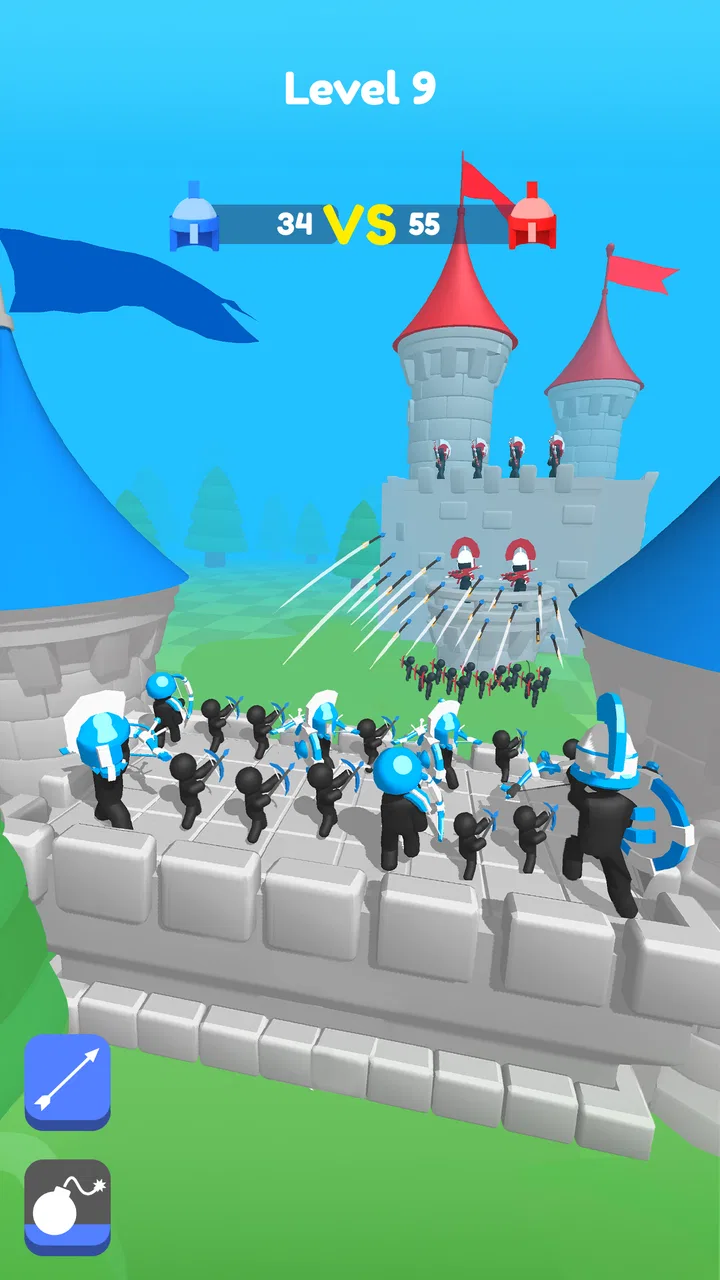
Merge Archers: Bow and Arrow
- 4.5
- Rating
- 50.00M
- Installs
- Free
- Price

 Analysis by App-foxy
I found Merge Archers: Bow and Arrow most enjoyable when I treated it as a quick tactical arcade game rather than a serious archery simulator. Its central idea is easy to understand: combine archers, build a stronger ranged force, and use that advantage to get through enemy waves. The appeal comes from the short decision loop. I am constantly choosing whether to improve what I already have, prepare for the next fight, or spend resources immediately for a faster result.
That simplicity is also the reason it works so well for casual play. I can open it for a few minutes while waiting for an appointment, make progress without learning a complicated control scheme, and put it down without losing the thread. At the same time, the merge mechanic gives each round a little more thought than a completely passive idle game. My overall view is positive: this is a polished choice for players who like light strategy mixed with arcade action, but it is not the best match for anyone looking for deep combat systems, realistic bow handling, or a campaign built around a rich story.
How the merging and archery loop feels in practice
The first thing that makes the game approachable is the clear relationship between merging and combat. Instead of asking me to master difficult aiming controls, it focuses my attention on improving the archers available to me. Combining units turns a simple collection of fighters into a more capable force, and that creates an immediate sense of progress even when I only have a short session.
You May Also Like

 Blood Strike: 2.5 Anniversary
Blood Strike’s Loadouts Turn Every Drop Into a Tactical Gamble
A close look at Blood Strike’s custom loadouts: how fast access to signature weapons reshapes its battle royale rhythm, rewards preparation, and narrows the gap between fights.

 Pandora - Music & Podcasts
Pandora’s Music Is Easy to Start, but Harder to Recover
Pandora’s strength is its low-effort path from a seed to a station. Its weak spot is how much confidence it asks you to place in connection, setup, and quiet recovery.

 8 Ball Pool
 Is Built on Rivalries, Rematches, and Routine
A close look at the rivalries, rematches, shared routines, and unanswered safety questions that turn a quick pool match into a persistent mobile community.

 Samsung Music
’s Quiet Strength Is Playing What You Already Own
Its reach comes less from spectacle than from dependable access to a personal library. That simplicity is both the app’s strongest retention engine and its ceiling.

 AccuWeather: Weather Radar
AccuWeather Review: A Quick, Clear Forecast for Everyday Decisions
For everyday plans, the best forecast is the one you can understand quickly. AccuWeather makes rain timing, radar, and local conditions easy to act on, with a few trade-offs.

 Hill Climb Racing
Why Hill Climb Racing Still Turns Crashes Into One More Run
A tiny car, a bumpy hill and one more upgrade: Hill Climb Racing keeps resurfacing because its simple chaos makes every near-miss feel personal.
More From Our News Desk



I like that the game makes preparation feel meaningful. A careless merge can leave the field less flexible than I expected, while a well-timed improvement can make the next encounter much easier. The best moments are not about tapping as quickly as possible. They come from noticing what I have available, deciding what can be combined, and judging whether I should strengthen one useful unit or build a broader group.
The archery theme gives the merge formula a stronger identity than a generic matching game. Ranged attacks make positioning and timing feel relevant, even though the experience remains firmly in the accessible arcade category. The result is easy to pick up for a first-time player, yet it offers enough small choices to stop every round from feeling completely automatic.
My practical advice is to avoid merging the moment a new unit appears. I get better results when I first look at the current battlefield and think about what the next encounter is likely to demand. Saving a possible combination for the right moment can be more useful than making the biggest upgrade immediately. This is one of the game's less obvious strengths: it rewards patience without becoming slow or intimidating.
Another useful habit is to separate short-term survival from long-term improvement. If I focus only on the strongest visible upgrade, I can overlook how many archers I will need to keep the fight moving. A balanced force is often more comfortable to manage than a single impressive unit. That trade-off gives the simple merge system a little more texture than the store summary suggests.
Why the controls suit short sessions
The control style is a good fit for touchscreens because the main interaction is direct and easy to read. I do not need to memorize a long list of commands before I can enjoy a round. That makes it suitable for players who want an uncomplicated game during a commute or a short break, especially when they would rather not commit to the concentration required by a traditional action game.
A realistic everyday use case is a ten-minute pause between errands. I can start a session, make a few upgrades, play through a small stretch of progress, and stop before the game becomes a major time commitment. It also works well when I want something more interactive than an idle title but less demanding than a full strategy game.
The compromise is that the controls do not create the precision or physical involvement of a dedicated archery game. Players who want to control draw strength, release timing, wind, or detailed shot placement may find the experience too streamlined. This is archery as a readable arcade theme, not a simulation of handling a bow.
Progression that feels rewarding, with limits
Upgrading archers gives the game a dependable sense of momentum. Each improvement helps me feel that the next challenge is within reach, and the merge structure makes progress visible rather than abstract. That is particularly effective for newcomers because the game communicates its basic goal through play instead of requiring a long tutorial or a complicated rules explanation.
Still, the progression is best enjoyed in moderate doses. Once I understand the most effective way to combine units, some of the surprise can fade. The game remains convenient, but players who need a large variety of builds or dramatic changes in strategy may eventually find the loop repetitive. Its strength is refinement and accessibility, not endless tactical discovery.
I also think the game benefits from setting a personal stopping point. Rather than continuing until every small reward feels routine, I prefer to finish a session after reaching a clear improvement and return later. That approach keeps the merge-and-battle cycle fresh. It is a useful way to manage the game's casual design, particularly for people who are susceptible to playing longer than intended when upgrades arrive at a steady pace.
What stands out after spending time with it
The strongest evidence in its favor is how quickly it communicates satisfaction. I can see the connection between a merge and a better-performing archer without having to inspect complicated menus. That clarity matters on a phone, where cramped interfaces and excessive systems can make a casual game feel like work.
The developer, CASUAL AZUR GAMES, has positioned this as a broad-access arcade experience, and the audience response reflects that reach. It has an average rating of 4.5 from around 62 thousand ratings and has passed 50 million installs. Those figures do not guarantee that every player will enjoy the same loop, but they do match my impression that the game is easy to understand and broadly approachable.
It is also free to start, which lowers the barrier for curious players. The age guidance is Everyone 10+, so families and younger players in that range can consider it, while parents should still remember that optional in-app purchases range from $0.99 to $99.99 per item. I would personally begin without buying anything and first decide whether the basic merge rhythm holds my attention.
The current version is 1.8.5, and the game supports devices using Android 7.0 or later. That makes the compatibility requirement relatively easy for many Android users to meet, although anyone using an older phone should check the system version before planning to play. The game is also available as a free arcade title rather than a premium purchase, which makes trying it low risk as long as I keep spending controls in mind.
One of the most useful ways to approach the game is to treat its upgrades as decisions, not decorations. I try to ask what problem an improvement solves. If the current difficulty comes from not having enough effective archers, I prioritize a merge that improves immediate output. If the problem is poor flexibility, I avoid consuming every available unit in one combination. This mindset makes the game feel more strategic without pretending it offers the depth of a larger tactics title.
A second tip is to use short sessions to test patterns. Instead of repeating the same action mechanically, I pay attention to whether early merging or delayed merging gives me more control later. That small experiment helps me learn the rhythm of the game and prevents the experience from becoming a sequence of unthinking taps. It is a modest form of self-directed strategy, but it adds value for players who enjoy optimizing simple systems.
The third insight is that the game can serve as a gentle introduction to merge mechanics. Someone who normally avoids strategy games may understand the cause and effect here quickly: combine units, improve the force, and face the next challenge. From there, the player can decide whether they want something more demanding. In that sense, it works as a bridge between a basic arcade game and more involved tactical titles.
The meaningful weakness: repetition and spending pressure
My main reservation is the limited complexity of the core loop. The same basic appeal that makes the game welcoming can also make it predictable. Once I know how merging affects my force and I have settled into a preferred rhythm, the excitement depends heavily on how much I enjoy incremental improvement. If I need frequent new mechanics, elaborate level design, or a strong narrative reason to continue, this may not hold my attention for long.
The free-to-play structure is another point worth considering. Optional purchases are not automatically a problem, but the listed price range reaches from small additions to a much larger single-item purchase. I recommend approaching the store carefully, especially if children use the device. The most comfortable experience for me is to enjoy the basic game first, decide whether it earns more of my time, and only then consider whether any purchase is genuinely useful.
This is also not the right choice for someone seeking a competitive archery test. The game uses bows and arrows as the theme for its arcade battles, but the satisfaction comes from merging and progression rather than from reproducing the physical challenge of aiming. A dedicated archery simulator would be a better option for players who care about shot technique, while a deeper strategy game would suit anyone who wants extensive unit roles, layered maps, or long-term planning.
There is a similar trade-off for players who prefer completely offline, interruption-free entertainment. A short casual game can be convenient, but anyone choosing it specifically for a quiet, premium-style experience should first consider whether the free-to-play format and optional purchases fit their habits. I would not recommend it blindly to someone who dislikes all forms of monetization or becomes frustrated by repeated upgrade prompts in mobile games.
Even with those limitations, I do not see the simplicity as a flaw for the intended audience. The game is not failing to be a large strategy adventure; it is choosing a smaller scope. The important question is whether that scope matches what the player wants. For me, it works when I want quick decisions and visible progress, but it becomes less compelling when I am in the mood for a game that keeps unveiling new systems.
Who should download it and who should skip it
I would recommend this to casual players who enjoy merge mechanics, light tactical choices, and a clear arcade presentation. It is especially suitable for someone who wants to play in brief bursts without studying a rulebook. The archery setting gives the familiar upgrade loop a bit of character, and the controls are approachable enough for players who do not normally play strategy games.
It is also a good fit for people who like making small optimization decisions. You can experiment with when to combine units, how aggressively to improve your force, and whether immediate power is more valuable than keeping options available. Those choices are not complex enough to overwhelm a beginner, but they are meaningful enough to make the game more satisfying than a purely passive progression app.
I would be more cautious about recommending it to players who want a substantial single-player campaign. The game is better understood as a repeatable arcade loop than as a story-led adventure. Likewise, fans of competitive multiplayer, realistic bow controls, or highly varied tactical roles should look toward other categories. This title is strongest when convenience and accessibility matter more than depth.
For families, the Everyone 10+ rating makes it a reasonable candidate for the appropriate age group, but the purchase range deserves attention. I would let a younger player try the free experience under normal device spending safeguards rather than assuming that the price label alone tells the whole story. For adults, the same advice applies in a simpler form: start free, observe how often the game asks for purchases, and decide based on actual enjoyment instead of the promise of faster progress.
If you are comparing it with usual merge games, the bow-and-arrow theme is the main distinction. It gives each upgrade a combat purpose and makes the results easier to understand than an abstract collection of objects. Compared with conventional arcade shooters, it is less about reflexes and more about preparation. Compared with full strategy games, it asks for far less time and concentration. That middle position is exactly where it makes sense.
My final view after playing
Merge Archers: Bow and Arrow succeeds because it keeps its central idea readable: improve archers through merging, then see whether those choices carry you through the next battle. I enjoyed the quick feedback, the low learning curve, and the small decisions about when to strengthen a unit. The game is easy to recommend as a free trial for anyone who wants a casual arcade experience with a touch of planning.
My recommendation comes with a clear condition. Go in expecting a compact, repeatable loop rather than a deep archery simulator or a large strategy campaign. Manage the optional purchases carefully, take advantage of short sessions, and experiment with timing instead of merging automatically. With those expectations, the game delivers a pleasant way to fill spare moments and offers just enough decision-making to stay active.
For me, the final verdict is that it is a solid choice for relaxed mobile play, particularly for newcomers to merge games and players who like visible upgrades. Its limitations are real: repetition can arrive, the strategic ceiling is modest, and the free-to-play purchase range requires awareness. But within its intended lane, CASUAL AZUR GAMES has made an accessible arcade title that is easy to start, simple to understand, and enjoyable when I want a small tactical challenge without a major commitment.
FAQs for Merge Archers: Bow and Arrow
01What is the objective of Merge Archers: Bow and Arrow?
Merge Archers: Bow and Arrow is a strategy game where players aim to build powerful archer units by merging identical ones. The primary goal is to defeat waves of enemies with your upgraded archers while strategically managing your resources and units to progress through increasingly challenging levels.
02How do I merge archers in the game?
In Merge Archers, players can merge two identical archer units to create a more powerful version. Simply drag one archer onto another of the same type, and they will combine to form a stronger unit. This mechanic is central to advancing in the game and overcoming tougher enemy waves.
03Are there any in-app purchases in Merge Archers: Bow and Arrow?
Yes, Merge Archers offers in-app purchases to enhance the gaming experience. Players can buy currency, special items, or upgrades that can help progress faster. While these purchases are optional, they can provide advantages in overcoming more challenging parts of the game.
04Is Merge Archers: Bow and Arrow suitable for all ages?
The game is generally suitable for all ages, with its bright graphics and straightforward gameplay mechanics. However, parental guidance is advised for younger players due to the potential for in-app purchases and the strategic thinking required to succeed in higher levels.
05Can I play Merge Archers offline?
Merge Archers: Bow and Arrow can be played offline, which is great for gaming on the go. However, some features, such as leaderboards or certain in-game events, may require an internet connection to access fully. Playing offline may limit the availability of these features.
Pros
- Engaging gameplay with strategic elements.
- Smooth graphics and intuitive controls.
- Variety of levels keeps content fresh.
- Regular updates with new features.
- Multiplayer mode enhances competition.
Cons
- In-app purchases can be expensive.
- Requires a stable internet connection.
- Ads can interrupt gameplay.
- Some levels may be too challenging.
- Limited customization options for characters.

Merge Archers: Bow and Arrow
Gallery